Service Dogs in Training in California: Do They Have Public Access?
This page explains the law in general terms. It is not legal advice. For a specific situation, contact the agency listed on this site or an attorney.
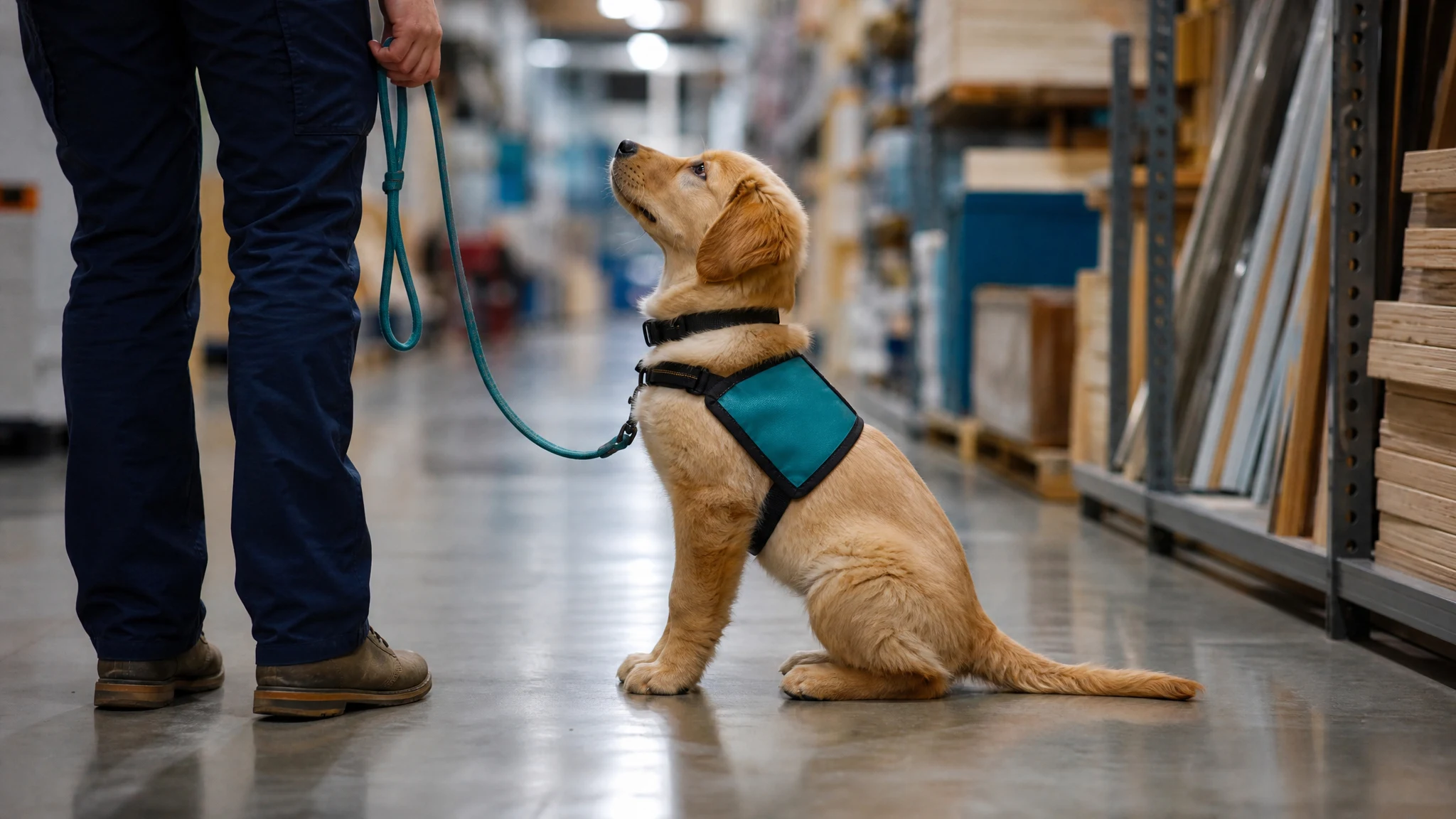
Short answer: sometimes, and only on conditions. The Americans with Disabilities Act (ADA) does not cover dogs in training. California law does. But California access for a dog in training depends on a leash and a county-issued tag, and both are easy to miss.
This guide walks through the steps for taking a dog in training into public places in California the way the statutes describe. It also covers what to do when you do not meet those conditions. It explains the law in plain English. It is not legal advice.
What the ADA says, and what California adds
The U.S. Department of Justice (ADA.gov) says that under the ADA, service animals are dogs individually trained to do work or perform tasks for people with disabilities. In its service animal FAQ, the Department of Justice also says dogs in training are not covered by the ADA and that some state or local laws do cover them.
California is one of those states. The California Civil Code (sections 54.1 and 54.2) and Penal Code section 365.5 each address dogs in training. Together they give a limited right of access, with conditions attached.
Two points from the Department of Justice FAQ are worth keeping in mind:
- People with disabilities may train their own service dog. Professional training is not required.
- Online service animal certificates and registrations convey no ADA rights, and the Department of Justice does not recognize them.
Who is covered in California
Civil Code 54.1(c) and 54.2(b) name three groups who may take a dog in training into covered places:
- Individuals with a disability.
- Persons licensed to train guide dogs under Business and Professions Code section 7200 and following.
- Persons authorized to train signal dogs or service dogs.
Penal Code 365.5(i) uses simpler wording: "any trainer or individual with a disability."
So access is not limited to professional trainers. A person with a disability who is training their own dog is within the language. The statutes say "persons authorized to train" signal and service dogs but do not define who does the authorizing. If you are unsure whether you qualify, ask your county animal services office or the California Civil Rights Department.
The statutes also do not state an age requirement for the dog.
Where access applies
Civil Code 54.1 gives full and equal access to public accommodations, medical facilities, transportation, housing offered for rent, and other places open to the public. The in-training provisions allow dogs in training into the same places.
Civil Code 54.2 also bars extra charges for the dog, including a security deposit. The handler is liable for any damage the dog causes.
For housing, the California Civil Rights Department's regulation (2 CCR 12005) lists service animals in training among the animals it treats as "service animals." Housing rules are a separate track from public access. Read them in that regulation or ask the Civil Rights Department.
What you will need
These are the materials California's rules point to:
- A leash. The dog must be on a leash in the places covered.
- An assistance dog identification tag. It is issued by the county clerk, animal control department or another agency under Food and Agricultural Code 30850 and following.
- Your county's application and affidavit form. The state statute has you sign an affidavit that cites Penal Code 365.7.
- Current dog license and vaccination records. The statute says owners must still meet local licensing and health rules. Orange County's form, for example, asks for a current rabies certificate.
- A training plan built on rewards. This keeps the dog calm and reliable in public. See the tips below.
Step by step: taking a dog in training into public places
Step 1: Confirm you fit a covered group
Check the three groups above. If you are an individual with a disability training your own dog, or a trainer, you are in the language of Penal Code 365.5(i). If you are licensed to train guide dogs, the Business and Professions Code license is the link.
Do not assume the rules cover a friend or family member who is simply helping with outings. The statutes name specific groups.
Step 2: Contact your county animal services office
The assistance dog tag program runs county by county. The Food and Agricultural Code says the local animal control department endorses the license application and issues a tag of uniform statewide shape, size and color, as specified by the California Department of Food and Agriculture.
Three examples of how counties handle it:
- Ventura County Animal Services issues an optional "ASSISTANCE DOG" tag after an Assistance Dog Identification Application and Affidavit Form.
- San Luis Obispo County Animal Services issues Assistance Animal Identification Tags to disabled county residents whose animal is individually trained to perform a task. For dogs, the tag also serves as the license tag.
- OC Animal Care uses an Assistance Dog Application and Affidavit that requires a current rabies certificate.
Tag fees were not published on those pages. Ask your county for its current fee and requirements. Ask directly whether a dog still in training is eligible, since each county writes its own form.
Step 3: Complete the application and affidavit
The affidavit cites Penal Code 365.7. That section makes it a misdemeanor to knowingly and fraudulently represent yourself as the owner or trainer of a dog licensed, qualified or identified as a guide, signal or service dog. The penalty is up to six months in county jail, a fine of up to $1,000, or both, according to the Penal Code.
Answer truthfully. The state also says the tag may be used only by a person with a disability or a trainer, and it must be returned when the dog dies or retires.
Step 4: Attach the tag and keep the dog on a leash
Under Civil Code 54.2(b), the dog in training must be leashed and tagged. Put the tag on the dog before you go. Keep the leash short and under control in doorways, aisles and parking lots.
Remember that you are liable for any damage the dog causes. Training outings are practice, and mistakes happen.
Step 5: Start small and build up
Begin in quieter, lower-pressure places and move to busy ones as the dog gets steadier. Short sessions are easier on a young or inexperienced dog. Several short, successful outings tend to teach more than one long, stressful one.
Step 6: Know what staff may and may not say
For a fully trained service dog, the ADA lets staff ask only two questions when the need is not obvious: whether the dog is a service animal required because of a disability, and what work or task it has been trained to perform. They cannot ask about the disability or require documentation or ID, according to ADA.gov.
Those ADA rules are written for trained service dogs, not dogs in training. If you are in a business and the dog is still in training, be ready to explain calmly that you are relying on California law, and have your tag visible.
Step 7: Have a plan for when you cannot show a tag
If you do not have a tag, or your county will not issue one yet, California law does not give you the same access right for a dog in training. In practice:
- Ask the business for permission before entering.
- Choose pet-friendly places for practice.
- Use private spaces, a yard, or a training class.
A "no" in that situation does not automatically mean the business broke the law. Check the statutes, or ask the California Civil Rights Department, before assuming it did.
Tips for smoother outings
- Use reward-based methods. The American Veterinary Society of Animal Behavior (AVSAB) supports reward-based training and advises against punishment-based tools and methods. Treats, praise and play help a dog feel safe in new places.
- Keep the dog's focus on you. A dog that ignores other people and dogs is easier for businesses to welcome.
- Carry the paperwork. Keep your county application copy and license records handy, so you can answer questions without a long conversation.
- Take breaks. A tired dog is more likely to make mistakes. End a session before the dog is overwhelmed.
- Read your county's page again. Procedures and forms can change.
Common mistakes to avoid
- Assuming the ADA covers a dog in training. It does not. California law may, but with conditions.
- Skipping the tag. The tag is optional for fully trained service dogs because the ADA bars requiring ID. For dogs in training, though, the California statutes make it a condition.
- Buying an online "registration" or certificate. There is no official service dog registry or required certification under the ADA, and the Department of Justice says online documents convey no ADA rights. A county tag is a local identification program, not a registry that proves a dog is a service dog.
- Confusing emotional support with service work. Under the ADA, dogs whose sole function is comfort or emotional support are not service animals. Emotional support dogs have a separate legal footing in California.
- Misrepresenting a pet as a dog in training. Penal Code 365.7 sets criminal penalties for fraudulent claims. Health and Safety Code 122319 sets separate civil penalties of $500, $1,000 and $2,500 for knowingly and fraudulently representing an emotional support dog as entitled to service dog rights.
- Forgetting local licensing. The Department of Justice says service animals follow the same local licensing, registration and vaccination rules as all dogs.
Expected results
Done carefully, these steps may help you take a leashed, tagged dog in training into places open to the public with a clear basis in California law. They may also reduce confusion at the door, since you can point to a county tag and the statutes behind it.
Results vary by county, by business and by how far along the dog is. A tag does not guarantee a smooth experience. If a business refuses entry anyway, stay calm, note what happened, and consider your options.
If access is denied
Civil Code 54.3 provides for civil damages: actual damages up to three times the actual damages, never less than $1,000 per offense, plus attorney's fees. Penal Code 365.5(c) makes interfering with a disabled person's access with a guide, signal or service dog a misdemeanor punishable by a fine of up to $2,500. Whether and how those provisions apply to a particular dog-in-training situation depends on the facts, so get advice on your specific case.
For complaints, the agency named in the statute is the California Civil Rights Department.
For a wider look at California's rules, programs and costs, see our guide to service dog training in California: laws, programs and costs.
Sources
- U.S. Department of Justice, ADA.gov: ADA Requirements: Service Animals
- U.S. Department of Justice, ADA.gov: Frequently Asked Questions about Service Animals and the ADA
- California Legislative Information: Civil Code 54.2
- California Legislative Information: Civil Code 54.3
- California Legislative Information: Penal Code 365.5
- California Legislative Information: Penal Code 365.7
- California Legislative Information: Food and Agricultural Code, Chapter 3.5
- California Legislative Information: Health and Safety Code, Article 4
- Cal. Code Regs. tit. 2, 12005
- California Civil Rights Department: complaint process
- Ventura County Animal Services
- County of San Luis Obispo, Animal Services
- OC Animal Care: Assistance Dog Application and Affidavit