Service Dog Tasks and the Public Access Test, Explained
This page explains the law in general terms. It is not legal advice. For a specific situation, contact the agency listed on this site or an attorney.
Two ideas sit at the center of almost every service dog question in California: the tasks the dog performs, and the public access test used to check the dog's behavior in public. They are often mixed up, and neither one is a registration or a certificate.
This guide shows how to define a task, teach it with reward-based methods, and use a public access test as a training benchmark. It also explains what the law does and does not require.
What counts as a task under the ADA
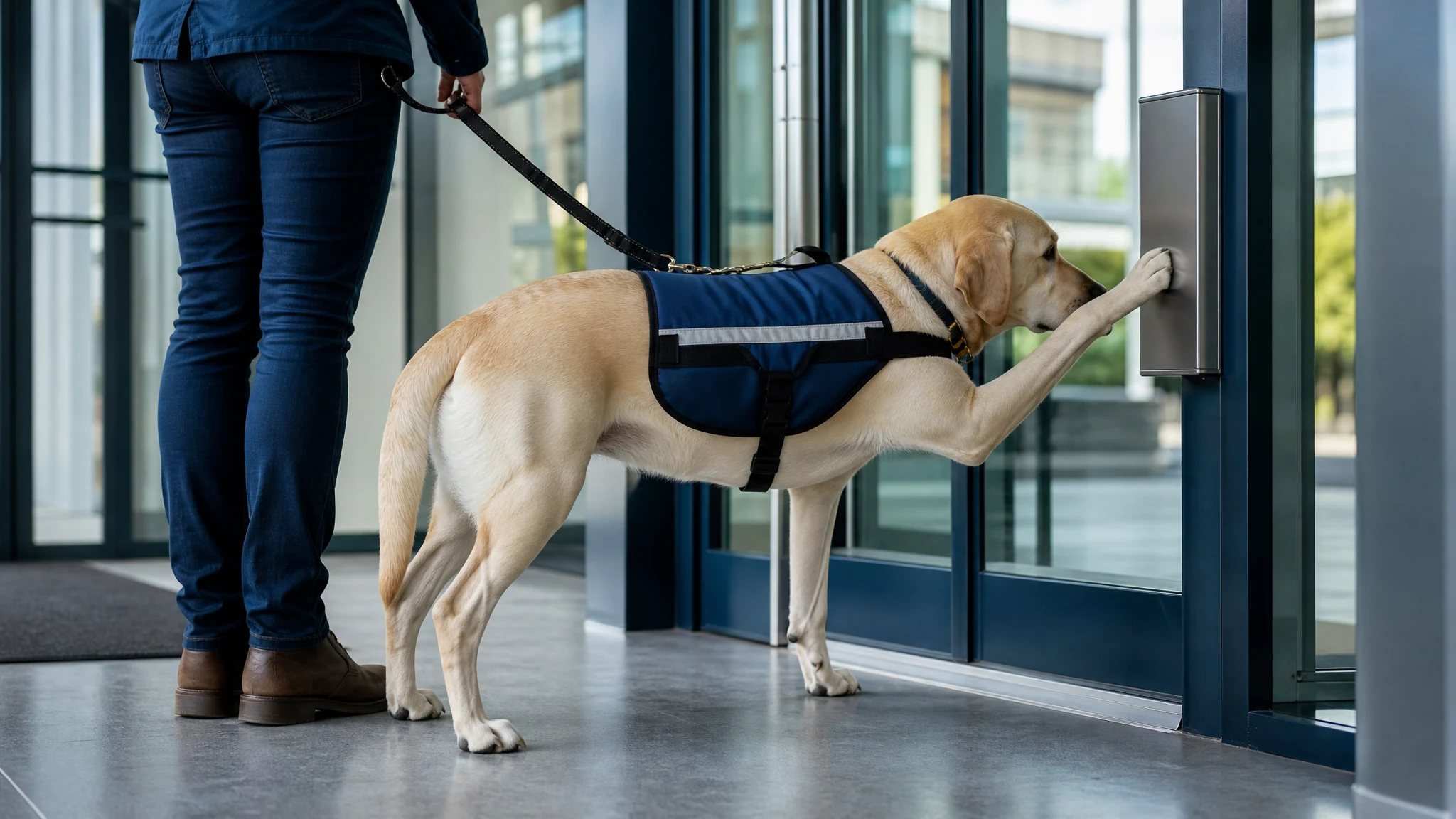
The U.S. Department of Justice (ADA.gov, "ADA Requirements: Service Animals") says a service animal is a dog individually trained to do work or perform tasks for a person with a disability. The task must be directly related to the person's disability.
That link is the test. Ask one plain question: what does my disability make hard, and what does this dog do about it?
California's statutes use similar language. Penal Code 365.5 and Civil Code 54.1 describe a service dog as a dog individually trained to do work or perform tasks for a person with a disability. The statutes name examples such as pulling a wheelchair and fetching dropped items. They also describe a separate category, the signal dog, which alerts a deaf or hard of hearing person to intruders or sounds.
Examples of tasks by disability
The list below is illustrative, not complete. Check ADA.gov for the federal definition when you are unsure whether something qualifies.
- Mobility disabilities: pulling a wheelchair and fetching dropped items, both named in the California statutes.
- Deafness or hearing loss: alerting the handler to sounds, which is the role of a signal dog in California law.
- Medical conditions: accredited programs such as Little Angels Service Dogs list diabetic alert, seizure alert and medical alert among the specialties they train.
- Psychiatric disabilities: Little Angels Service Dogs and California Service Dog Academy both list psychiatric service dog work. The California statutes do not name psychiatric disabilities, but Civil Code 54.1(d) treats any ADA violation as a violation of 54.1 too.
- Autism and veterans' needs: programs such as Canine Companions list autism and veteran placements among the dogs they train.
- Vision loss: guide dogs, trained by programs such as Guide Dogs for the Blind.
Why comfort alone is not a task
The ADA.gov definition is exact on this point. Dogs whose sole function is comfort or emotional support do not qualify as service animals. Emotional support, therapy and comfort animals are not service animals under the ADA.
A dog that calms you by being near you is doing something valuable, but it is not a trained task. A dog trained to interrupt a specific behavior, or to apply pressure on cue when it notices the early signs of an episode, is performing work tied to the disability. The difference is the training and the action.
California also treats these animals differently in different settings. The state's housing regulation (2 CCR 12005) covers emotional support animals as "support animals" for housing. The employment regulation (2 CCR 11065) also covers support animals as a reasonable accommodation. Public access under the ADA is a different matter, and it applies to trained service dogs. Our guide to service dog training laws, programs and costs in California covers the legal side in more detail.
What the public access test is, and what it is not
A public access test is a hands-on check of how a dog behaves in everyday public places. Assistance Dogs International (ADI), the group that accredits many assistance dog programs, uses a public access standard for the dogs its member programs place. Look to ADI directly for the current test wording.
It is a training benchmark. It is not a legal requirement under the ADA, and passing it does not create a legal right. The ADA.gov FAQ is clear that the ADA does not require service dogs to have ID, and it does not recognize online certification or registration documents.
The test is still worth using. It gives you a concrete way to see whether your dog is ready for stores, clinics and restaurants, and it helps you spot weak areas before they cause problems.
What you need before you start
- A dog with a stable temperament, in good health, and old enough to handle training sessions without stress.
- A written list of the specific tasks your disability calls for.
- Small, soft, high-value treats and a clicker or a marker word such as "yes."
- A flat buckle or harness setup and a standard leash. Training methods here are reward-based, in line with the American Veterinary Society of Animal Behavior (AVSAB), so no shock, prong or choke collars.
- A notebook or phone to log sessions, including date, place, and what went well.
- A helper, such as a friend or family member, for distraction practice.
- If you are training in public in California, the county assistance dog identification tag and a leash (more on this below).
Step-by-step: from task to public access readiness
Step 1: Write down each task and its link to your disability
For every task, write one sentence: "When [situation], my dog [action], which helps me with [limitation]." If you cannot finish the sentence, the behavior may be a comfort behavior rather than a task.
Keep the list short at first. Two or three reliable tasks are better than ten shaky ones.
Step 2: Build basic manners first
Tasks rest on a base of calm, simple skills: sit, down, stay, loose-leash walking and a dependable recall. Practice at home, then in a quiet yard, then on a quiet street.
Reward the behavior you want and keep sessions short. Five focused minutes, repeated, usually works better than one long, tiring session.
Step 3: Teach each task in small pieces
Break a task into tiny steps and reward each one. For fetching a dropped item, the pieces might be:
- Touch the object with the nose.
- Pick it up.
- Hold it for a second or two.
- Carry it a few steps.
- Place it in your hand.
Add a cue only after the dog does the behavior reliably. Then add the real-life trigger, such as an actual dropped item, so the dog learns to respond to the situation and not only to your words.
Step 4: Make the task reliable in new places
Dogs often forget what they know when the setting changes. Move each task to a new room, then outdoors, then somewhere with mild distractions. Lower your expectations a little in each new place and reward generously.
Step 5: Add public-place manners
Public readiness covers more than tasks. Practice these with a reward-based approach:
- Walking past people, carts and other dogs without pulling or lunging.
- Settling under a table or beside a chair and staying put.
- Ignoring dropped food and passing strangers.
- Waiting calmly at doors and in lines.
- Staying relaxed during noises, such as a dropped tray.
Step 6: Understand California's rules for dogs in training
The ADA does not cover dogs in training, according to the ADA.gov FAQ. Some state laws do. California does.
Under Civil Code 54.1(c) and 54.2(b) and Penal Code 365.5(i), a trainer or an individual with a disability may take a dog being trained into the same public places as a trained service dog. The dog must be on a leash and wear an assistance dog identification tag issued by the county clerk, animal control department or other agency under Food and Agricultural Code 30850 and following sections. The person is liable for any damage the dog causes.
The statutes do not state an age requirement. Guide dog trainers must be licensed under Business and Professions Code 7200 and following sections. For signal and service dogs, the statutes say persons authorized to train, so do not assume that only professional trainers qualify.
Tag programs are run county by county. Ventura County Animal Services, San Luis Obispo County Animal Services and OC Animal Care each publish an application, and each asks the applicant to sign an affidavit. Contact your own county's animal services department for its form and any fees, since the fee was not published on the pages we cite.
Step 7: Run a practice public access test
Choose a store, a clinic waiting room or a quiet cafe where you are allowed to be. Bring your helper and your treats, and plan a short outing.
Watch for the following, and write down what you see:
- Does the dog stay with you on a loose leash?
- Does it settle when you stop?
- Does it ignore food, people and other animals?
- Does it perform a task on cue when asked?
- Does it recover quickly from a surprise?
Do not treat this as pass or fail. Treat it as a map of what to practice next. For the official ADI wording, check with ADI or with an ADI member program.
Step 8: Repeat, and stop when the dog is struggling
Repeat the outing in different settings over several weeks. If the dog shows stress, such as panting, yawning, hiding or refusing treats, end the session, go back to an easier place and rebuild. A stressed dog learns poorly and may not be right for public work.
What to expect in public
You are not required to carry papers for a fully trained service dog. The ADA.gov guidance on service animals says that when the need for the dog is not obvious, staff may ask only two questions:
- Is the dog a service animal required because of a disability?
- What work or task has the dog been trained to perform?
Staff cannot ask about your disability, ask for documentation or ID, or ask for a demonstration. Knowing your task list well helps you answer the second question in a sentence or two.
The ADA.gov FAQ also says a person with a disability may train the dog themselves. Professional training is not required. Service animals still follow the same local licensing, registration and vaccination rules as every other dog, and the ADA does not permit mandatory service-animal registration.
Tips and common mistakes
- Calling comfort a task. If the dog's only role is to be present and soothing, it is an emotional support dog, not a service dog under the ADA.
- Buying a certificate or registration. There is no official service dog registry or required certification under the ADA. ADA.gov says online certification documents convey no ADA rights.
- Misrepresenting a dog. California Penal Code 365.7 makes it a misdemeanor to knowingly and fraudulently represent yourself as the owner or trainer of a guide, signal or service dog. The penalty is up to six months in county jail, a fine up to $1,000, or both. A separate law, Health and Safety Code 122319, sets civil penalties of $500, $1,000 and $2,500 for knowingly and fraudulently representing an emotional support dog as a service dog, or for sellers who skip the required notice.
- Rushing public outings. Move at the dog's pace, not the calendar's.
- Using harsh tools. Shock, prong and choke collars, alpha rolls and dominance methods are not part of humane, reward-based training.
- Skipping health and licensing. Keep vaccinations and the local dog license current.
Expected results
With steady, reward-based practice, many handlers find that a dog learns a simple task in a matter of weeks and becomes reliable in public over a longer stretch. Timelines vary a great deal with the dog, the task and the handler's schedule, and there is no guarantee that a particular dog will be suited to service work.
A practice test may help you see progress and decide what to work on next. Some dogs are better suited to a different role, and that is a fair outcome.
If your rights are denied
California Civil Code 54.1 gives people with disabilities full and equal access to public accommodations, and Civil Code 54.2 bars extra charges or deposits for the dog. Penal Code 365.5(c) makes interference with access a misdemeanor with a fine of up to $2,500. Civil Code 54.3 allows damages of actual damages up to three times that amount, never less than $1,000 per offense, plus attorney's fees.
The California Civil Rights Department (CRD) handles complaints. This article states the law and is not legal advice.
If you want a program instead
You do not have to train alone. ADI-accredited programs in California include Canine Companions, Guide Dogs for the Blind, Guide Dogs of America, Pawsitive Teams, Freedom Dogs, Little Angels Service Dogs, Sam Simon Foundation, California Service Dog Academy and Paws for Purple Hearts. Costs, waitlists and eligibility differ, so confirm details with each program.
Little Angels Service Dogs and California Service Dog Academy list that they will consider working with an owner and their personal dog. Canine Companions states that its dogs are free of charge to those it serves. California Service Dog Academy showed applications as closed on October 16, 2026, so check its site for current status.
Sources
- U.S. Department of Justice, ADA.gov: ADA Requirements: Service Animals
- U.S. Department of Justice, ADA.gov: Frequently Asked Questions about Service Animals and the ADA
- California Legislative Information: Civil Code 54.2
- California Legislative Information: Civil Code 54.3
- California Legislative Information: Penal Code 365.5
- California Legislative Information: Penal Code 365.7
- California Legislative Information: Food and Agricultural Code, Chapter 3.5
- California Legislative Information: Health and Safety Code, Article 4
- California Code of Regulations, tit. 2, 12005
- California Code of Regulations, tit. 2, 11065
- California Civil Rights Department: complaint process
- Assistance Dogs International: California member search
- Ventura County Animal Services
- County of San Luis Obispo, Animal Services: Assistance Animal Identification Tags
- OC Animal Care: Assistance Dog Application and Affidavit